Texture Mapping

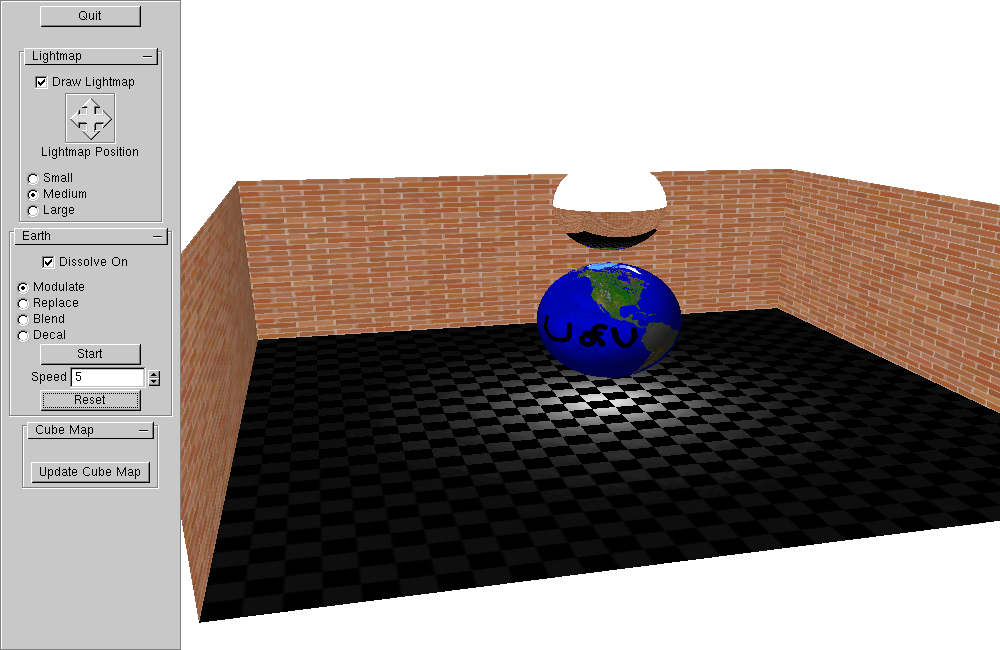
Texture mapped a 4-sided room such that one wall has front-side culling applied. The floor is texture mapped using a checkerboard image and also feature mip mapping. The walls of the room are a repeated brick texture. There is a floating sphere in the center of the room texture mapped with the image of the earth. There is a control feature which “dissolves” the earth image into an image of my face. The “dissolve” is controlled using a set of interface controls which starts/stops/resets and varies the speed of the dissolve. Also included is a lightmap with multi-texturing for the floor. The lightmap only lights a small spot on the floor and acts like a “flashlight”. The interface controls also provides 4 main modes of texturing: modulate, replace, blend, and decal which is applied to the earth texture. Lastly, there is a reflective or environment mapped sphere in the scene which was created using a cube map.

You might be interested in …

Hatching Shader

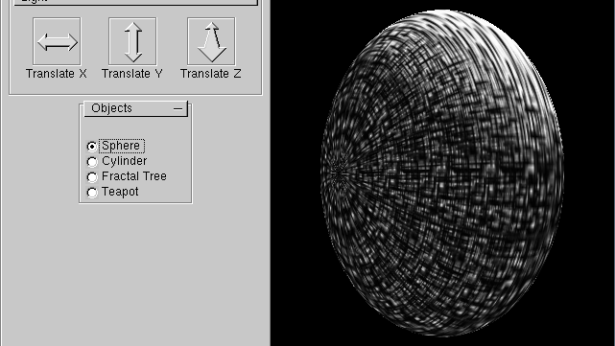
This is a shader implementation of Real-Time Hatching, Praun et al. [2001]. The scene contains a real-time rendering of hatching strokes over various objects. They use tonal art maps containing different stroke sizes and density at various resolutions. Using these tonal art maps, we can render strokes on complex surfaces.

Read More

Procedural Textures

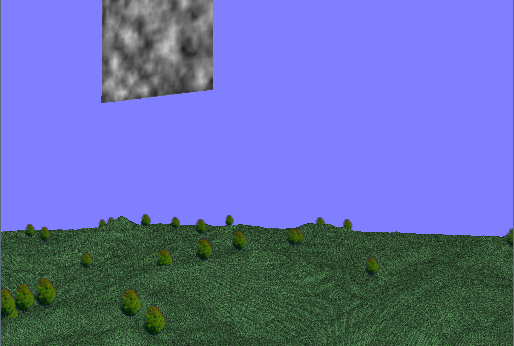
The terrain was created using the same method as the “Procedurally Generated Terrain” project. The procedural texture is based on a noise algorithm. The trees are a texture-mapped image of a tree onto a rectangle. The alpha channels of the tree are transparent. The trees have billboarding apply so that the tree rectangles turn to […]

Read More

Procedurally Generated Terrain

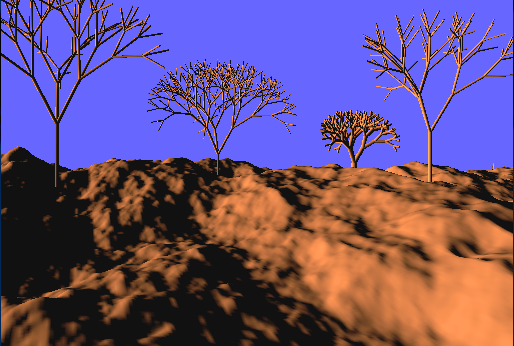
The ground is procedurally generated using a random midpoint method and smoothed using a neighborhood smoothing filter. The trees were generated by different procedural rules. The scene uses OpenGL material and lighting.

Read More